
Survivor Story
Shloyme Shoikhet, born 1937
The Cart and the Frightened Horses
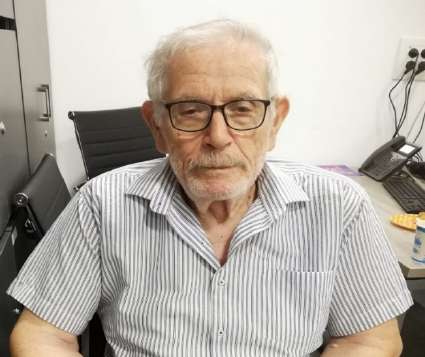
Sadly, I was too young to remember everything. Mostly this is what I heard from my parents.
When the war began I was not yet four. Before the war we lived in the village of Klyasnitsa in the Izmail region. There were five people in our family. When the war began, the order came to evacuate our village. Our family evacuated almost last. First we were to reach Odessa, but it turned out the Germans were already there. Then we decided we had to reach Tashkent, remembering that my mother's sister lived there. My brother remembered our aunt's address, and that is where we went.
The road was hard. First we traveled by cart, drawn by two horses, but at one point the horses became uncontrollable and bolted down a slope that ended in a ravine. We could all have died. Fortunately, women working in the field stopped the frightened horses by waving their kerchiefs in front of them, and we were saved from death. After that incident my father gave up the cart, and we set off for the nearest train station, where with great difficulty we were placed in a freight car heading to Tashkent.
“Women working in the field stopped the frightened horses by waving their kerchiefs in front of them, and we were saved from death.”
Because of my disobedience our family was placed on an open platform of the train, on which stood the equipment of some factory. During rain and strong wind we covered ourselves with the ends of a tarpaulin. On sunny days it was very hot. At one stop, at my mother's request, we were transferred to a closed freight car, and so we were able to continue our journey to Tashkent. Before reaching the station, it was announced that Tashkent was not accepting refugees. My parents decided to get off the train before the station and walk to Aunt Fanya. After a couple of hours we reached the house where my mother's sister lived.
We somehow squeezed into her small two room apartment and lived there until we found housing with a clay floor and walls of adobe brick. It was very cold. We warmed ourselves under cotton blankets that lay around the table. I remember that feeling even now.
Children loved to play with dust, mixing it with water to make a clay grenade, and those were our toys. We made friends with the local children, Uzbeks and other refugees. There I learned to smoke early, mostly cigarette butts. Life was hard, and the feeling of hunger never left us.
Some time after we arrived, my parents began looking for work. They had no education. My father got a job at a wagon repair plant that produced military equipment for the front. The work in the shop was continuous, they did not let him go home even at night, and he stayed at the factory. The workers there had a deferment from front service.
My brother entered the Tashkent Industrial Institute, but on my parents' advice he dropped out and went to work at the same plant where my father worked. In 1942 he was sent to the Kharkov tank school, and in 1943 he was drafted into the army at the front.
My mother had no permanent work, and to feed us she took on anything. She tried to work in places where food was made, and for a long time she worked nights at a bread factory, where after work she could get pieces of bread with crumbs. The years 1942 to 1945 were hungry years. My sister and I felt it often. We had to eat sugar beet and the husks of cottonseed. In summer it was easier, because in Tashkent there were many vegetables and fruits.
On May 9, 1945 the war ended. Tashkent celebrated the victory. My brother had not yet returned from the war, his unit had been transferred to Manchuria, to Port Arthur. My parents decided to stay in Tashkent and wait for Misha to return.
Now we live in Israel and are happy to be on our native land.
About this story. Recorded and edited for Light of Care. Stories are preserved as told and lightly edited for clarity.